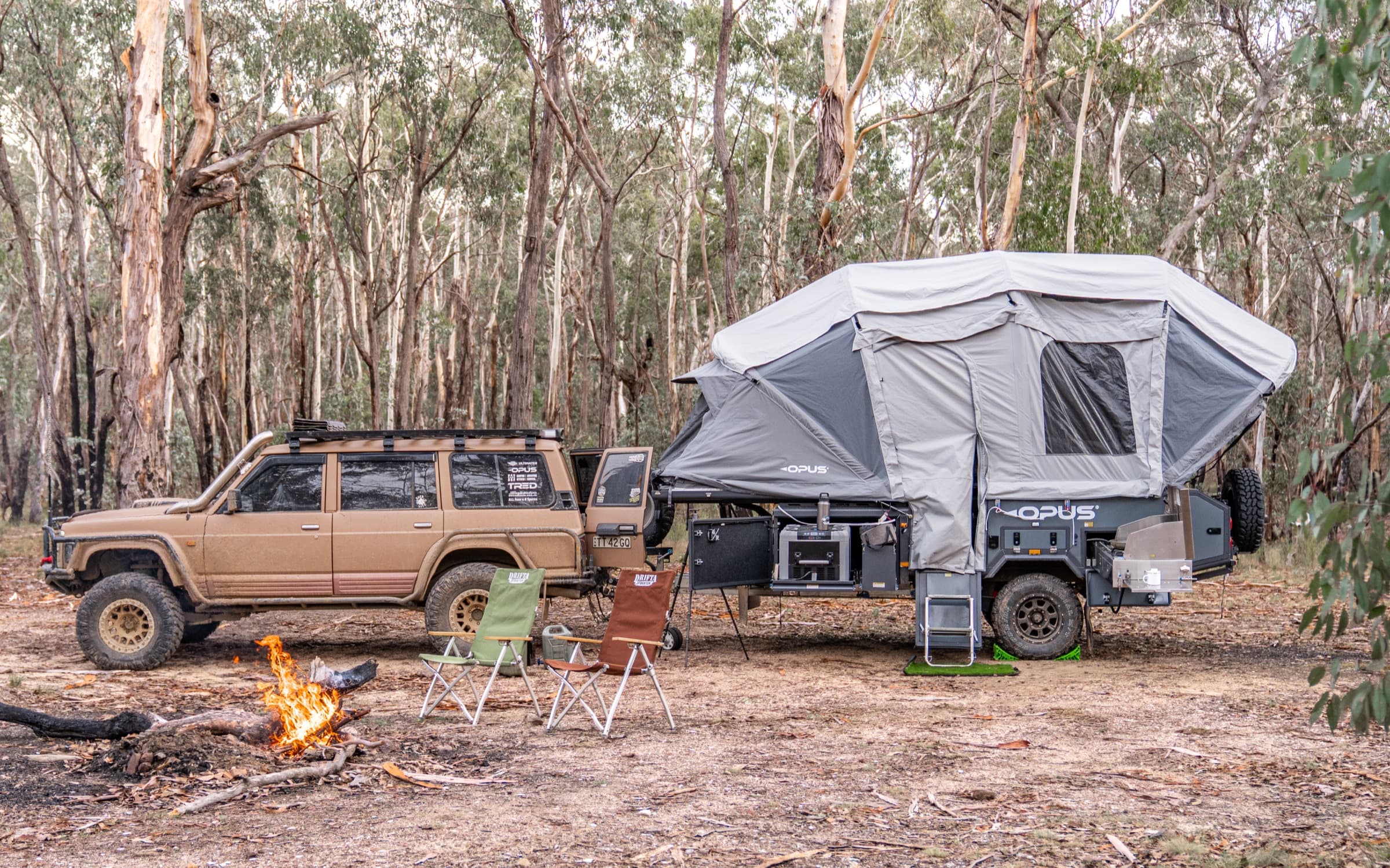
The short answer: a camper trailer is lighter, easier to tow and gets further down rough tracks, and you set up a tent when you arrive. A hybrid caravan is roughly a tonne heavier, but it's a hard-walled van with a real bed, kitchen, fridge and air conditioning that's ready the moment you unhitch. If you want to go further on a smaller tow vehicle, go camper trailer. If you want home comforts on long trips and have the vehicle to tow 3,000 kg, go hybrid.
What's the difference between a camper trailer and a hybrid caravan?
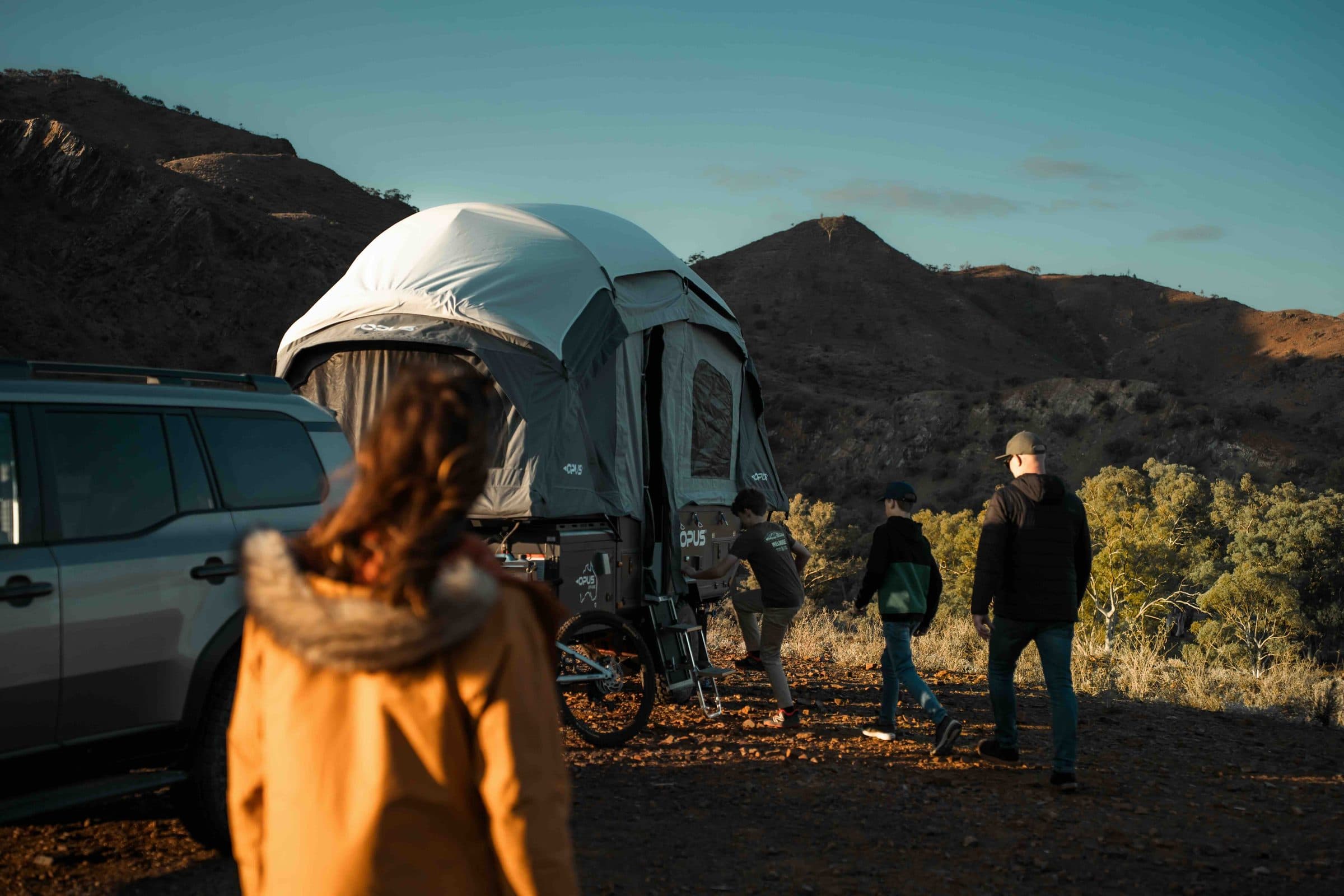
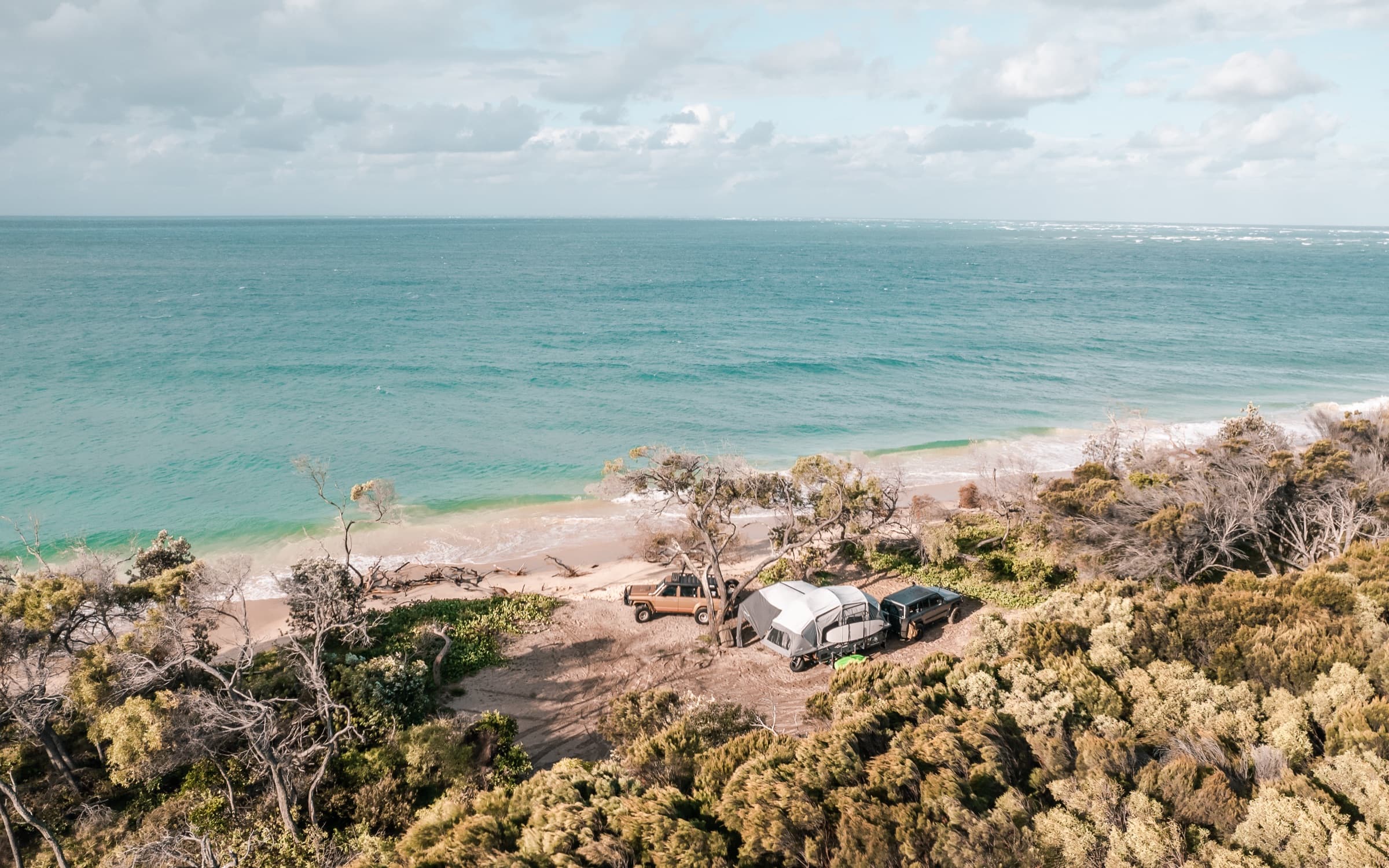
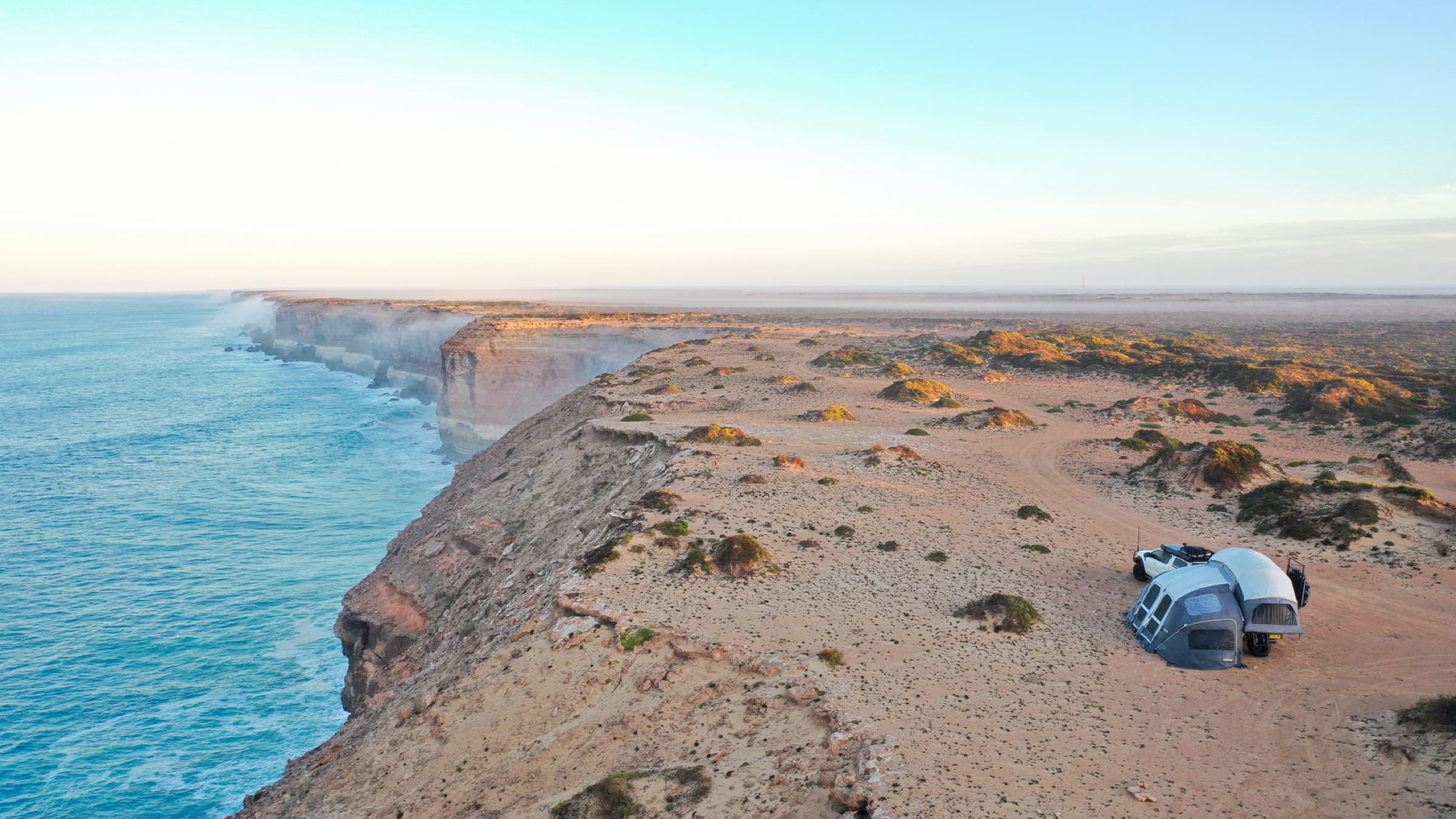
A camper trailer is a compact off-road trailer that unfolds into a tent at camp. Your bed, kitchen and storage live in a low, tough box that tows like a heavy-duty box trailer. The OPUS LITE, OP2 and OP4 use Air Beam Technology: the tent inflates rather than relying on poles, so it stands up in minutes.
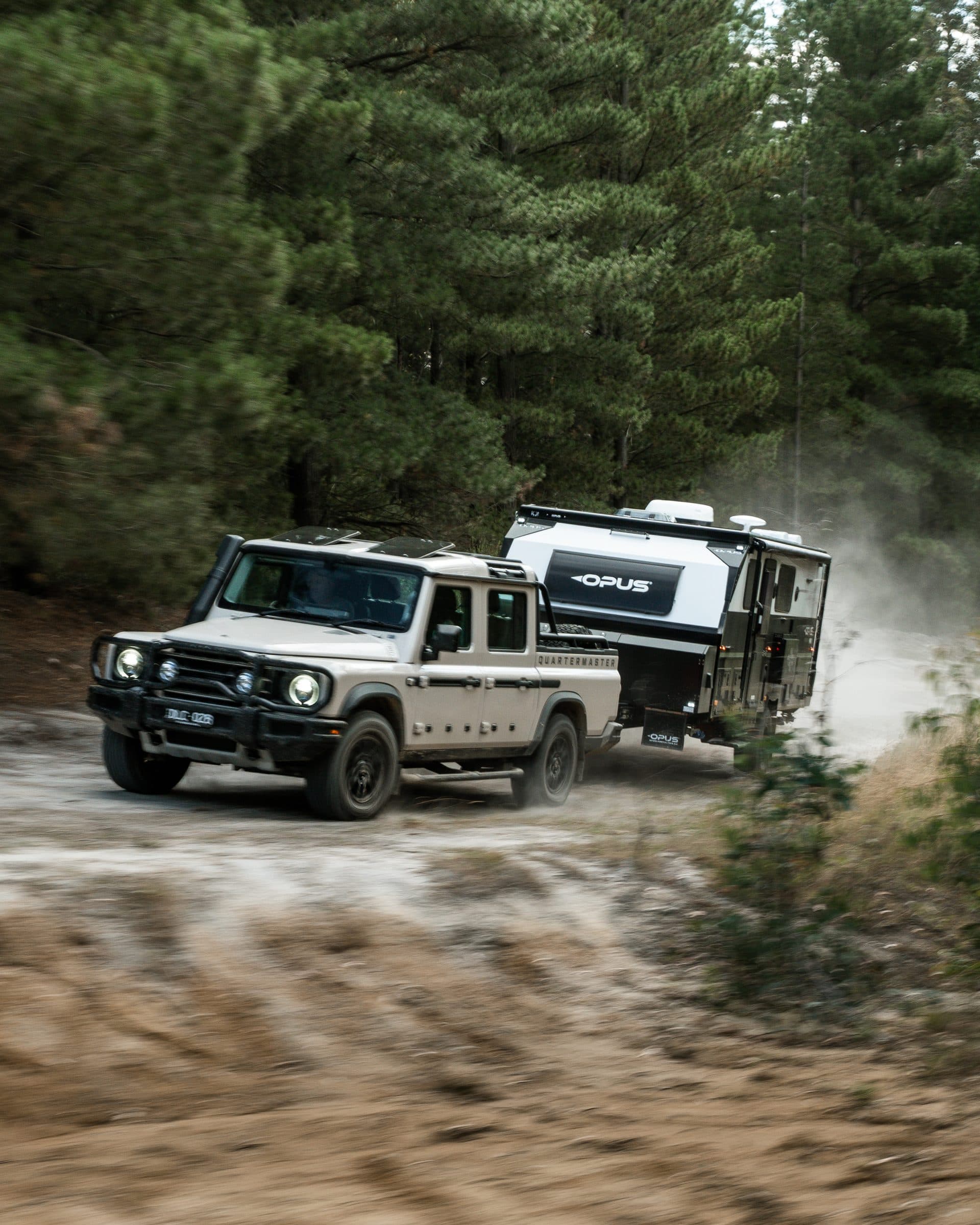
A hybrid caravan sits between a camper trailer and a full-size caravan. It's a compact, hard-walled van built on an off-road chassis, with the bed, kitchen and living space inside. The OPUS Expedition Max and Expedition Pro are hybrids, each available as a Pop Top or Hardside.
How do they compare on weight and towing?
Weight is the biggest difference, and it decides what you can tow with. Here's the OPUS range, as published:
| Model | Type | Sleeps | Tare | ATM | Ball weight |
|---|---|---|---|---|---|
| LITE | Camper trailer | Up to 4 | 1,040 kg | 1,600 kg | 130 kg |
| OP2 | Camper trailer | Up to 4 | 1,470 kg | 1,990 kg | 150 kg |
| OP4 | Camper trailer | Up to 6 | 1,600 kg | 1,990 kg | 180 kg |
| Expedition Max | Hybrid caravan | 4 – 5 | 2,430 kg (Pop Top) | 3,000 kg | 260 – 265 kg |
| Expedition Pro | Hybrid caravan | 2 | 2,400 kg | 3,000 kg | 235 kg |
The camper trailers top out just under two tonnes ATM, which suits a wide range of 4WDs and larger SUVs. The hybrids sit at 3,000 kg ATM, so you need a vehicle rated to tow at least that much, with a tow ball rating to match. Our guide to what your 4WD can tow walks through the numbers to check.
Which is faster to set up?
A hybrid wins on arrival: there's no tent, so you level it up and you're in. That said, a modern camper trailer is nothing like the canvas-and-poles wrestle you might remember. Every OPUS camper trailer sets up in under five minutes, because Air Beam Technology inflates the tent in one go. If you move camp every day, a hybrid saves you a few minutes each time. If you stay put for a few nights, the difference disappears.
Which goes further off-road?
Both are built for dirt. The OPUS camper trailers and hybrids share a galvanised chassis and the Cruisemaster DO35 off-road hitch, which articulates through ruts and washouts where a standard ball coupling would bind.
The camper trailer has the edge on genuinely tight, technical tracks. It's shorter (the OP4 is 5.60 m long against 7.80 m for the Expedition Max), lower, lighter, and sits up high: the OP2 and OP4 have 390 mm of ground clearance. Less weight behind you also means less strain on your vehicle on steep climbs, sand and corrugations. The hybrids run independent coil suspension with Pedders shocks and handle remote corrugated roads with ease, but their size and weight make the tightest tracks harder going.
Which is more comfortable on long trips?
The hybrid. The Expedition Max carries 240 L (2 × 120 L) of fresh water, a 600 Ah Renogy lithium battery bank, 800 W (4 × 200 W) of solar, a Dometic 130 L fridge and reverse-cycle air conditioning. That's weeks off-grid with the comforts of home, and a hard roof over your head when the weather turns.
The camper trailers are well equipped for their size. The OP4 carries 140 L of water and 2 × 100Ah Lithium, enough for an active family to stay off-grid for days at a time. The tent is roomy, and you can add an annexe for even more space.
Which suits families, and which suits couples?
- Families on a smaller tow budget: the OP4 sleeps up to six on the rig itself, and the annexe adds room for four more.
- Families who want a hard-walled van: the Expedition Max sleeps 4 – 5, with a bunk layout available on the Hardside.
- Couples who want to go anywhere: the OP2 sleeps up to four, with a king bed for the two of you.
- Couples who want home comforts: the Expedition Pro is a hybrid built around two people, with a queen bed and the full off-grid kit.
- Lightest possible tow: the LITE, at 1,040 kg tare, is the lightest in the range.
So which should you buy?
Choose a camper trailer if you want to go further down rough tracks, your vehicle isn't rated to tow 3,000 kg, or you'd rather spend less up front and on fuel. Choose a hybrid caravan if you're planning long trips, want a hard-walled bed every night with no tent at all, and have the vehicle to tow it.
The best way to decide is to stand in both. Walk through every model at an OPUS showroom, or spec one up in Build & Price to see your tow-away price.