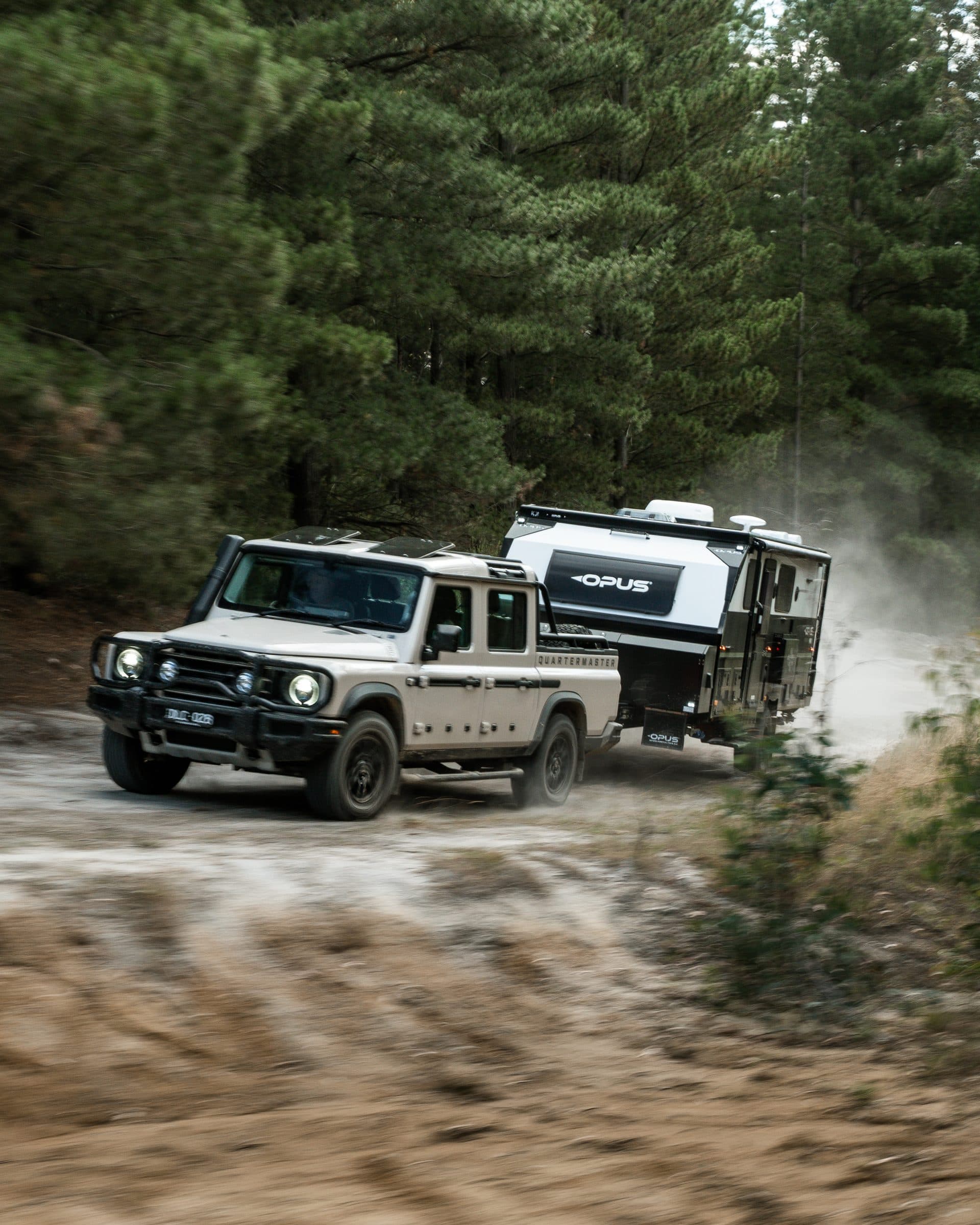
The short answer: check four numbers on your vehicle, not one. With the camper loaded for a trip, it must stay within your vehicle's braked towing capacity, its maximum tow ball download, its GVM (the most the vehicle itself can weigh) and its GCM (the most the vehicle and trailer can weigh together). The simplest safe test is to compare against the camper's ATM, because that's the most it can legally weigh.
This is general information to help you shortlist. Your vehicle manufacturer's ratings and your state's transport authority have the final say.
Which numbers do I need from my vehicle?
You'll find these in your owner's manual, on the manufacturer's website, and in part on the compliance plate. Your towbar also carries its own rating, and the lowest of the vehicle and towbar ratings is your limit.
- Braked towing capacity: the heaviest trailer with brakes your vehicle is rated to tow.
- Maximum tow ball download: the most weight the trailer can press down on your tow ball.
- GVM (Gross Vehicle Mass): the most your vehicle can weigh, including passengers, fuel, gear, accessories and the tow ball download.
- GCM (Gross Combination Mass): the most your loaded vehicle and loaded trailer can weigh together.
- Kerb weight: what your vehicle weighs empty with a full tank. GVM minus kerb weight is your vehicle's payload.
What do tare, ATM, ball weight and payload mean on a camper?
- Tare: what the camper weighs empty, as built.
- ATM (Aggregate Trailer Mass): the most the camper can weigh fully loaded. This is its legal limit.
- GTM (Gross Trailer Mass): the loaded weight carried by the camper's own wheels when it's hitched up, which is the ATM minus what sits on the tow ball.
- Ball weight: how much of the camper's weight presses down on your tow ball.
- Payload: ATM minus tare. Water, gas, food, gear and any accessories you add all come out of payload.
How do I check if my vehicle can tow it?
Work through these four checks with the camper loaded the way you'll actually travel. Here's how it looks for an OPUS OP4, which has a 1,990 kg ATM and 180 kg ball weight:
- Towing capacity. Your vehicle's braked towing capacity should be at least 1,990 kg, so you can load the OP4 right up to its ATM and stay legal.
- Tow ball download. Your vehicle and towbar need a maximum tow ball rating of at least 180 kg, and more once you've loaded the front of the camper.
- GVM. The 180 kg on the tow ball counts as load on your vehicle. If your vehicle has 700 kg of payload, the ball weight leaves 520 kg for passengers, fuel, gear and accessories like a bullbar, roof rack or drawers.
- GCM. Add up the loaded vehicle and the loaded camper. The total must be under your GCM.
Why does GCM catch people out?
Many vehicles can't hit their maximum towing capacity and their GVM at the same time. Take an example vehicle (example numbers, not a specific model) with a 3,500 kg towing capacity, a 6,000 kg GCM and a 2,300 kg kerb weight. Tow 3,500 kg and the vehicle itself can only weigh 2,500 kg, which leaves just 200 kg for the family, fuel, gear and accessories. In practice that means towing less than the brochure figure, or carrying less in the car. Always run the GCM check, especially if your vehicle is heavily accessorised.
Do I need electric brakes and a brake controller?
Under Australian rules, a trailer weighing over 750 kg must have brakes. Over 2,000 kg, it needs brakes on every wheel and a breakaway system that stops the trailer automatically if it ever comes off the tow ball. Every OPUS camper trailer and hybrid runs electric brakes, which means your vehicle needs an electric brake controller fitted. If yours doesn't have one, you can add it when you spec your rig in Build & Price.
Where does the OPUS range land?
| Model | Tare | ATM | Ball weight | Payload |
|---|---|---|---|---|
| LITE | 1,040 kg | 1,600 kg | 130 kg | 560 kg |
| OP2 | 1,470 kg | 1,990 kg | 150 kg | 520 kg |
| OP4 | 1,600 kg | 1,990 kg | 180 kg | 390 kg |
| Expedition Max | 2,430 kg to 2,490 kg | 3,000 kg | 260 – 265 kg | 510 – 570 kg |
| Expedition Pro | 2,400 kg | 3,000 kg | 235 kg | 600 kg |
- LITE: the lightest in the range at 1,040 kg tare and a 1,600 kg ATM, so it opens up a lot of SUVs and smaller 4WDs. Check your rating, but you may not need a big 4WD at all.
- OP2 and OP4: both have a 1,990 kg ATM, just under two tonnes. Most mid-size and large 4WDs are rated to tow this, but check the tow ball rating too.
- Expedition Max and Expedition Pro: a 3,000 kg ATM means you need a vehicle rated to tow at least 3,000 kg braked, with a tow ball rating to suit the 235 kg to 260 – 265 kg ball weight. Large 4WDs and dual-cab utes are the usual match, and the GCM check matters most here.
Five habits for towing safely
- Weigh it for real. Before a big trip, run your loaded vehicle and camper over a public weighbridge, together and separately. It's the only way to know your actual numbers.
- Watch the ball weight. A common guide is around 10% of the trailer's loaded weight on the tow ball. Too little can make the trailer sway; too much overloads your rear axle.
- Load low and central. Heavy gear goes low and over the camper's axle, not at the very front or back.
- Remember water is heavy. Every litre weighs a kilogram, so full tanks eat payload fast. Travel with what you need and top up near camp.
- Check your state's rules. Towing speed limits, mirrors and licence requirements vary by state.
Not sure where your vehicle lands? Bring your vehicle's details to an OPUS showroom and we'll help you match the right model to it.